
A People Approach – The People Snapshot
The People Snapshot
Every dairy farm relies on people. Whether it is a single operator or a large team, the goal should be to run the farm without people problems holding the business back. To attract and keep good people, farms need to be competitive workplaces, not just competitive businesses.
People efficient farms usually have:
- a clear strategic vision
- the right infrastructure and resources
- well defined roles and responsibilities
They are organised, productive and good places to work. These farms invest in technology, keep systems simple, and design work so people can do it well.
They also use good people practices, such as:
- clear recruitment and contracts
- position descriptions and standard operating procedures
- strong safety systems
- induction and training
- regular reviews and meetings
- flexible, reasonable rosters
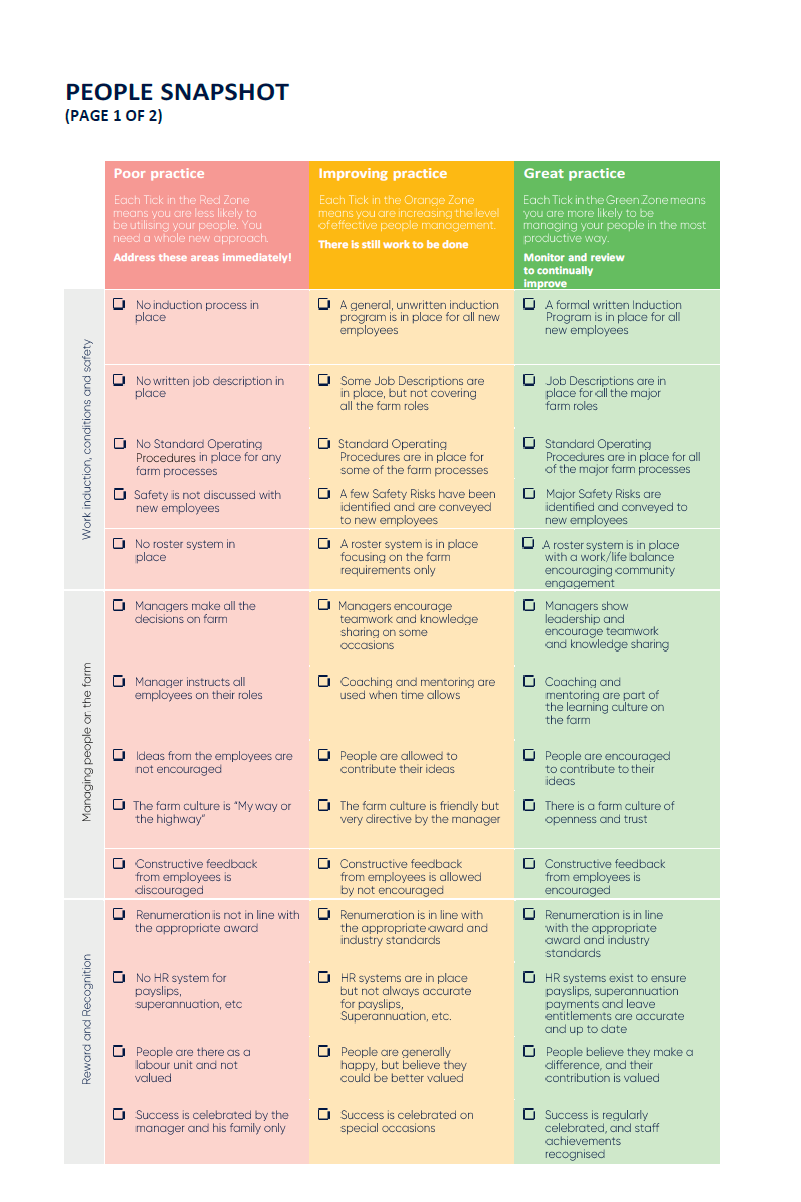
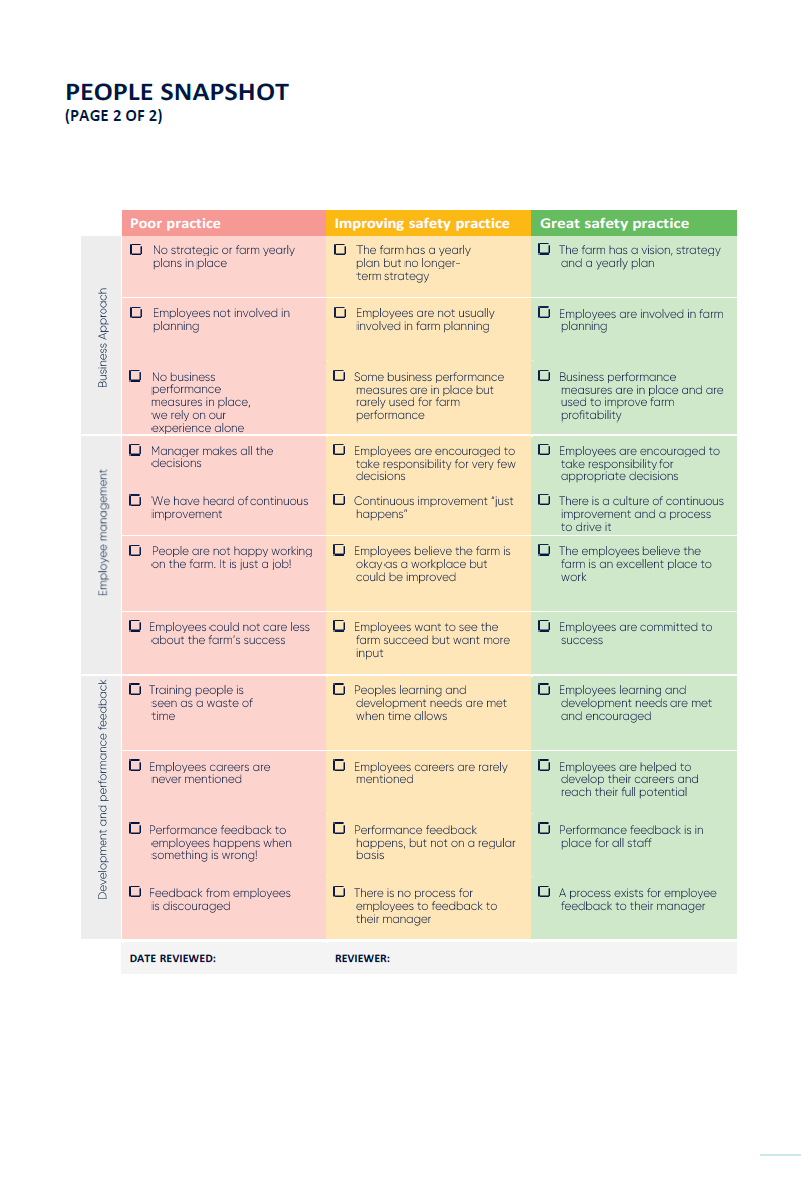
Where to start: The People Snapshot provides an easy to use self-assessment tool to help identify areas in which you are doing well and others areas that need your attention.
Most farms face similar challenges:
- attracting and keeping good people
- balancing work and personal life
- being fairly rewarded
- managing risk
Four guiding principles help:
- Think about everyone on the farm, not just employees.
- Adapt the way the farm operates so it works well for people.
- Make sure the right people are in the right roles at the right time.
- Build and maintain good working relationships.
Use practical steps, seek advice when needed, and involve both on farm and off farm team members in planning.
Useful Links
Contracts and Agreements
Webpage
Position Descriptions
Webpage
Induction and Onboarding
Webpage
Standard Operating Procedures
Webpage
Farm Policies and Procedures
Webpage
Communication
Strong teams rely on good communication. It means people can share what they’re thinking and others actually hear and understand it. Even though it sounds simple, breakdowns happen often at work. On a dairy farm, open communication helps everyone:
- set clear expectations and coordinate jobs
- build trust and feel part of the team
- share information and solve problems together
- work from facts instead of assumptions
- give feedback and recognise good work


Improving communication on the farm: There are many ways to share information – quick chats, whiteboards, texts, and regular meetings. A few simple techniques make a big difference.
Ask better questions: Use questions that invite discussion, not just “yes/no” answers. Open questions (how, what, why, when, where, which) help people explain what they think and feel. They’re also useful when interviewing.
Listen properly: Plans change – droughts, floods, busy calving. Good communication means listening to understand, offering reassurance, and stepping in to help when needed. Sometimes problems are just different personalities or work styles.
Be clear when you explain things: Think about your message, state the key points, and explain why something matters. Clear instructions reduce mistakes. For example, instead of “Go get the cows,” give details about where they are, what to check, and what to do next.
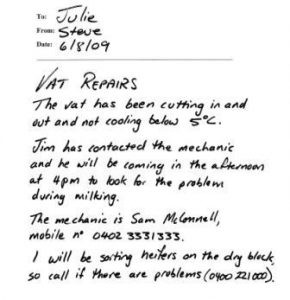
Put important messages in writing: Notes, whiteboards, and texts are great for detailed instructions – especially across shifts. Make sure someone keeps boards updated. But if something is important, write it and follow up with a conversation.
Give feedback regularly: Feedback keeps standards on track and lets you recognise good work.
- Praise motivates when it is specific and genuine.
- Corrective feedback should happen early, focus on behaviour (not the person), and check whether training or resources are the issue.
A helpful model: “I like…” (what’s working) then “I would like…” (what needs to change).
Support learning: Coaching, mentoring, and “buddy systems” help people develop skills and create a culture of helping each other.
Leadership on Farms
A leader motivates people to work toward a shared goal. On a dairy farm, leadership has a big impact on results. Trust, consistency and respect are the foundations. Good leaders encourage, listen and support their team.
What good leaders do
- challenge how things are done and look for improvement
- share a clear vision and get others on board
- help people work together and build trust
- lead by example and live their values
- recognise effort and celebrate success
Qualities people value
- integrity (most important)
- competence
- forward thinking and vision
- enthusiasm and passion
Leadership styles: Different situations need different styles. Examples include:
- authoritative
- democratic
- coaching
- pacesetting
- coercive
No single style works all the time. Coaching often suits farm teams, but effective leaders adjust their approach as teams develop and needs change.
Positive Farm Culture
Leaders set the tone. When leaders model good behaviour and support their team, they shape a positive culture – “the way we do things here.”
Culture includes attitudes, values, expectations, and how people treat each other. Some rules are obvious (turn up on time). Others are unwritten (how we handle personal issues).
Teams can’t control milk prices or the weather – but they can control how they respond. Farms with a positive culture are seen as great places to work, attract good staff, and handle change better.
People work best when they know what’s expected and feel supported. Trust, honesty, and open communication are essential.
How to build it – A positive environment helps people feel safe, motivated, and willing to give their best:
- Agree on shared values (honesty, reliability, respect, initiative).
- Make sure leaders live these values.
- Share them clearly with new staff — a simple values statement or code of conduct helps.
Foster collaboration – Working together well helps farms run smoothly, reduces conflict, and builds trust:
- Help people understand each other’s work styles.
- Share information openly and regularly.
- Give constructive feedback focused on the issue, not the person.
- Use differences to solve problems, not create conflict.
- Involve staff in procedures and decision-making.
- Encourage idea-sharing and set ground rules for openness.
- Use technology and standard operating procedures wisely.
- Hold regular meetings and review performance at least twice a year.
- Conduct exit interviews when someone leaves to learn and improve.
Team Meetings
Team meetings help build a strong and positive team culture. They give people time to talk, understand priorities, and feel included in decisions.
Weekly meetings keep day to day work on track. Monthly meetings help the team plan ahead and improve how things are done. Good meetings usually:
- start and finish on time
- have a clear agenda
- give everyone a chance to speak
- stay focused on the main issues
It also helps to write down actions at the end. Record what needs to be done, who will do it, and when it should be finished. Follow it up at the next meeting.
When meetings are run this way, people feel respected. Communication improves. And the team works together more confidently and effectively.
Setting team goals
Clear goals help people understand where the farm is heading and how their work contributes. Without goals, teams often get stuck in day to day tasks and lose focus on the bigger picture.
Start with the farm’s strategic plan. Resource it properly, then align team goals with business goals.
Good team goals should: Clear goals give people direction and help everyone work toward the same outcome.
- match the overall direction of the business
- be written down and measurable
- be used to track performance and give feedback
Teams can set goals across areas like production, stock, pastures, infrastructure and people. Keep them realistic and review them regularly.
It can help to involve the whole team, and even some off farm advisers, when setting goals. If planning feels difficult, get help from someone with planning experience.
The Right Mix of People
Good farms need good teams. People have different needs, personalities and work styles, so it helps to understand and work with those differences.
Personality tools like DiSC can be useful for discussion. They are only guides. No one fits perfectly into one box, and any style can succeed in dairy.

Managing Conflict
Conflict is not always bad. Handled well, it helps teams learn, improve and adapt.
Good teams talk openly, negotiate, and look for solutions together. Clear policies, roles, communication and values all help prevent problems.
Focus on needs, not just solutions. Agree on a simple process for working through issues. Useful principles:
- talk about the issue, not the person
- listen first and understand why it happened
- acknowledge facts and emotions
- stay calm and give people time
- summarise what you heard
- agree on a way forward and review progress
Sometimes managers need to experience the problem firsthand. If conflict continues, involve a neutral third party. Recurring conflict usually means the real cause has not been addressed.
Work–life Balance
Farming is demanding and because many farmers live where they work, it’s easy to end up “on the job” all the time. Balance looks different for everyone, but getting it right matters: it reduces burnout, improves health, and helps people stay longer.
Good work–life balance isn’t always about fewer hours, it’s about flexibility and smart rosters.
Practical ideas – These ideas help protect work life balance and keep people healthy and motivated:
- talk openly about time-off needs
- use flexible rosters (especially for parents and carers)
- allow part-time or job-share options
- offer time off in lieu when possible
- provide basic facilities (showers, lockers, kitchen)
- support health checks
- avoid glorifying long hours – lead by example
- celebrate achievements outside work
- plan rosters so everyone can have real time away
When pressure increases, balance problems show up quickly. Encourage people to be clear about what matters to them at work and at home – and design rosters that support it.
Managing time: Good time management means balancing doing the work, managing the work, and planning for the future. Planning helps you prioritise what matters most and keeps the business on track. Practical tips:
- create a yearly seasonal plan
- use a wall planner for visibility
- prioritise important jobs first
- use technology wisely to save time
- delegate tasks that take too long or block others
Rosters: Poor rosters and constant extra hours damage work life balance and make it hard to keep staff. Short busy periods are manageable, but ongoing tough conditions eventually push people away. Good rosters:
- are clear and consistent, and only changed when necessary
- consider weekly hours and reasonable breaks
- include leave and ensure cover when people are away
- support a healthy work life balance
- follow the Pastoral Award 2020 and National Employment Standards
Design rosters with people in mind, not just tasks. Check everyone’s hours, bring in extra help if needed, and ask staff about their preferences. Different people value different types of breaks, so build that into the plan.
Changing regular rosters or hours: Under the Pastoral Award 2020, employers must consult employees before changing regular rosters or ordinary hours. This means:
- explaining the proposed change
- asking for employee feedback, including family or caring impacts
- genuinely considering that feedback
This applies to full time, part time and casual staff. Employees can have a representative, and any disputes are managed through the award’s dispute resolution process.
| Shift type | Weekend work | Working days per fortnight |
Hours b/w shifts | |
| Highly unattractive and/or uncompetitive conditions likely to be impacting attraction and retention for the farm | Split shifts or long day shifts (10-12 hours+) | Often, expected, no reward in pay or time off | 12-14 | <10 |
| Some unattractive and/or uncompetitive conditions | Set day shifts | Expected weekend work with some reward in pay or time-off | 11 | 10 to 14 |
| Relatively attractive conditions, likely to be attractive and competitive to potential employees | Day shifts that meet employee needs (e.g. early finish) | Little or no weekend work and rewarded through extra pay or time off | 10 or otherwise employee requested | >14 |


